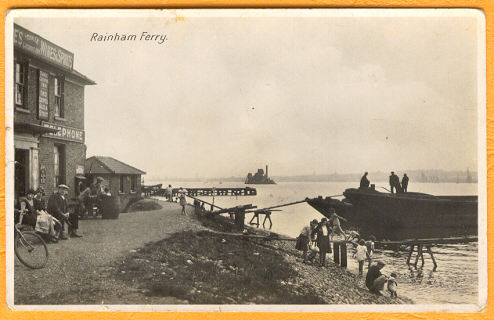
Landlords, legends, census records, and lost taverns.
Rainham Ferry is first named in in 1531. The Ferry House, later The Three Crowns, was certainly in existence in 1556, “Rychard Wtkin of Raynom Fere doth keep and ale house”. There are burials at Rainham in 1574 and 1590 for Henry Bates, John Waterman and William Watkin, servants at “the Ferry house” or “Ferry”. In 1591 there is a birth registered, ”Grace, base daughter of Bounsinge Bess, servant, Ferry House”. In 1580 Thomas Wiseman of Great Waltham devised the alehouse, ferry, and two adjoining marshes to his grandson William Wiseman. William Wiseman sold them in 1598 to Sir Robert Southwell.
In 1729 the Ferry house (part of the Berwick and Moorhall estate) was sold to Sir Thomas Crosse, a Westminster brewer and also the Westminster M.P. By 1769 the Ferry House was renamed The French Horn. In 1772 the name was changed to The Three Crowns though for much of its history it would continue to be referred to as the Ferry House. A 1789 indenture shows a lease for 1500 years to Thomas Berney Bramstone from John Godsalve Crosse.
In 1804, the Romford brewer, Edward Ind, bought the property from John C. G. Crosse. By 1827 the Romford brewers had sold it on again, to the innkeeper, John Wade. In 1834 the Three Crowns was burnt down. Joseph Lee purchased the land. A new building was opened on 29th December 1839 and let to Richmond the brewers for £18 per annum.
The 1841 Census records Mary Collins, victualler, at the Three Crowns and the Parish Rate Book of August 1840 shows Collins as resident and Lee as owner. The Ferry House, Rainham was insured, with several other pubs, by Samuel Strong and Henry Larchin, brewers of Ratcliffe Cross, in 1840 and 1841.
On 25th November 1842, a former resident of “the Ferry Hotel (commonly known as the Three Crowns Tavern, Rainham Ferry), Rainham in the County of Essex, Licensed victualler”, Henry Fetherston, was the subject of an insolvency hearing in the Court House, Portugal Street, Lincoln’s Inn Fields. When he was at the Three Crowns is not recorded.
From about 1850, the Margate paddle steamers called at Rainham ferry. In the 1860s there was a hard leading from the inn to the low water mark, and in the early 20th century a narrow wooden pier surmounted it. Into the 1950s it was still possible to cross the river in a small boat or barge. Rainham Ferry grew as a small hamlet, with a few cottages and the inn, the Ferry House. At one point there were as many as 200 inhabitants but by 1945, apart from the Three Crowns, there are no residents at Rainham Ferry.
White’s Dirctory of 1848 lists William Gore at the Three Crowns and in 1851 and 1852, John Heathcote is listed in directories. The 1851 Census has Francis Benton as innkeeper with his wife Mary, and children. After the death of William Gore, the Three Crowns Inn was sold by auction in 1857
“RAINHAM FERRY, ESSEX – Messrs. Hart and Sons have received instructions from the executors of the late Mr. John Gore of Paddington, to SELL BY AUCTION, on Wednesday, May 13th, 1857, at twelve for One o’clock, at the Auction Mart, near the Bank of England.
All that Freehold old and well established inn known as THE THREE CROWNS and TWO COTTAGE and GARDEN, also a plot of ground, having a river frontage, loading dock yard, stabling, coach house, and other out-buildings. Estimated rental £30 per annum.
Also the LEASE of a piece of excellent Marsh Land, containing about four acres, and an Island* of Reed Shore, containing about Nine acres, with two Cottages thereon, held for an unexpired term of5 ¾ years, at £31 10s per annum. This property is calculated for the purpose of a depot or manufactory, which would be objectionable near the Metropolis.
Also the LEASE of a piece of Reed Shore, opposite the Island, held for an unexpired term of 6 ¼ years, at the very low rent of £8 or annum.
Descriptive Particulars with Conditions of Sale may be had at the Mart; the Three Crowns Inn, Rainham Ferry; of SAMUEL ABRAHAMS, Esq. Solicitor 4, Lincoln’s Inn Fields, London and of HART and SONS, Ascott, near Leighton Buzzard.”
At some point Thomas Woodfine, owner of the Hornchurch Brewery, held the lease of the Three Crowns. In any event, William Clapham appears to have acquired the inn or was installed as the landlord after this sale. Clapham was resident in Rainham Ferry by 1859 when he is named in a court case as the seller of illegal “government stores” to a William Sinnott. William Clapham is a “publican” in the 1871 Census. William Clapham, landlord of the Three Crowns beerhouse, Rainham, was charged with allowing beer to be drunk upon his premises during illegal ours on Sunday, the 10th December (1871). William Clapham died on 15th April 1877 and administration of his effects, valued at less than £200, was granted the following month. His wife Jane then took over the licence.
The Three Crowns was sold to the Ind Coope Brewery in 1876. In 1881, Jane Clapham is listed as “innkeeper” in the Census. Her tenure was not without problems, seemingly common at the Three Crowns, cut off from where many people lived, and depending on visiting trade, lightermen and other workers on the river and the surrounding marshland and the growing noxious industries.
The Brentwood Petty Session held on 20th March 1884 heard cases involving the sale of diluted spirits at the White Hart, Hacton, The Angel Inn, Rainham and The Ferry Inn, Rainham. “Jane Clapham, landlady of the Ferry Boat Inn. Rainham, for selling a quart of gin degrees under proof, was fined 10s. and 7s. costs”.
The 1891 Census is significant for the future story of the pub as it lists Jane’s grandchildren Susan Boys (17) and Harry Boys(12) living with her. The difficulties of running the Three Crowns are evident again in 1894, “James Farrance, Peter Peacock, and John Gibbs, young men, for being disorderly and refusing to quit the Three Crowns Inn, on March 13th, were each fined 7s. 6d. and 6s. costs.”
Jane Clapham died on 20th August 1899, though probate wasn’t granted until May in 1900. On November 3rd 1899 the licence of the Three Crowns was transferred to Charles Albert Gibbs who was executor of Jane Clapham’s will. In order to gain probate he faced a court case with Jane’s son William.
“In the probate division on Thursday 3rd May 1900 before Sir Francis Jeune and a common jury, the case of “Gibbs v Clapham” was continued. This was a suit arriving out of the testamentary dispositions of the late Mrs. Jane Clapham, of the Three Crowns, Rainham, who died on August 20, 1899. The plaintiff, Charles Alfred Gibbs, as sole executor of the last will of the testatrix bearing date July 11, 1898, claimed probate of that will. The defendant, William Clapham, the son of the testatrix, pleaded, among other things that the alleged will was obtained by the undue influence of the testatrix’s grandson, Harry Boys.
Mr. Grazebrook said the testatrix was an old lady, and in July 1898, she sent a message to Mr. Adams, of Romford, a public-house broker,asking him to come over and prepare her will. The will was prepared and executed, but the testatrix did not die until more than 12 months later.
Thomas Adams said his ‘fee’ for preparing the will was two guineas. He had not acted as a solicitor in other legal matters, but he had prepared, perhaps a score of wills in all.
Mr. Gibbs, the plaintiff, in cross examination, was asked by Mr. Barnard whether the testatrix was not very much afraid of her grandson, Harry Boys. The witness replied ‘Afraid! About as much as I am of you. (Laughter). Why the old lady would not eat her breakfast unless Harry Boys was with her.”
Mr. Barnard-‘Was the testatrix of sound mind?”
Witness-‘Her mind was as sound as mine’
Harry Boys denied that the will was obtained by any undue influence on his part. He had not threatened to shoot one of his aunts and had never expressed the intention of being-‘The Boss’-after his grandmother’s death.
Margaret Webb, a daughter of the testatrix, said that ‘after the death of her father the children agreed to leave their mother in possession. She agreed not to make any will depriving the children of their rights under the father’s intestacy. Harry Boys had been prevented from striking his grandmother and he had threatened to put a bullet through her (Jane Clapham)”.
It emerged in court that their father, William Clapham, was insolvent when he died in 1877 and that Jane Clapham had been offered £700 for the goodwill of the Three Crowns.
William Clapham, the defendant denied that he had ever received a loan of £200 from the testatrix. Under cross examination, William Clapham said “Harry Boys used to drink as much as he did, and he had seen him, ‘rascally fresh”.
The case was adjourned and concluded on Tuesday 8th May 1900. In summarising, the judge stated that there was ample evidence that the will had been drawn up properly and that Jane Clapham was of sound mind when it had been made. Regarding the serious charge of undue influence, involving fraud and coercion, he said “This was a charge which, though frequently made, he had never heard established in the course of his judicial experience.” He had actually tried to convince Mr. Barnard, for Clapham not to proceed with his evidence. The jury immediately found in favour of the plaintiff, Mr Gibbs.
It emerged in the court that Mr Adams had made a valuation of the Three Crowns for probate, after Jane Clapham’s death, with a figure of £190 16s. 6d., of which £100 was in respect of the ‘goodwill’. In reality, there was little to inherit. The 1901 Census lists 23 year old Harry Boys as the licensed victualler. A 35 year old wharf labourer, Charles Gibbs, is a boarder. Is he the “gentleman” named as executor, who took the licence in 1899 and fought the case against William Clapham? Certainly, Charles Gibbs appears at the Three Crowns in the 1902 Kelly’s directory.
On Friday 1st September 1905 the Three Crowns licence was transferred from Charles A. Gibbs to the next landlord, Robert Greening at the Grays Petty Session. Greening had moved to the Phoenix by 1912. He was succeeded briefly, by Jame Puttock who was followed shortly afterwards by Henry James Hill who remained there until 1923 when Arthur Harold White took over the pub.
White had a barge builders yard at Rainham and the running of the pub was carried out by a manager, Charles Robert Bifield, beginning a long association with the Three Crowns and the Rainham district for the family who are very well remembered in the village.
The Romford Petty Session of 20th February 1936 heard a case against Charles Bifield, manager of the Three Crowns, for Arthur H. White, the owner, accused of selling Edward Wright “intoxicating liquors after hours (at 2.30pm) on December 29th 1935”. The defence of all three was that the incident didn’t take place after hours. Mr Bifield said he had set his watch by the Memorial Clock in Rainham and had called time at 2pm. He said, “The clock in the bar was kept fast on Sundays, because that was the only day on which there were customers. The house was kept on because the licensee (Mr. White) was in business in the neighbourhood. It had been derelict and when opened, 18s. was taken on the first day”.
White said he had been connected with the business for 25 years and had never had a complaint. Mr. Bifield denied that he had sold a drink after time and Wright said that he had no drink after time and others gave similar evidence. However, all three were fined.
An aspect of Charles Bifield’s evidence is particularly interesting. He stated that he had been manager of the Three Crowns Inn for 13 years and that “there was no local trade, the only customers being visitors”. The light, passing trade, was however, swollen on holidays and a marvellous photograph from 1931 shows the pub with a large crowd enjoying the riverside.
By 1937, Robert Biggin Stokes had taken over the Three Crowns and he appears on the 1939 Register with his wife Mabel. The growing Murex site and the increasing security measures during the war further isolated the Three Crowns and in 1951 it closed and was soon subsumed into Murex. Murex actually tried to block the public footpath from the Three Crowns to Coldharbour with a gate, and appealed against the inclusion of the footpath as a public right of away.
Essex County Council were supported by Rainham historian, Frank Lewis, who assembled historical evidence and witnesses who had used the footpath for many years. At the Essex Quarter Sessions Appeal Committee hearing in May 1959, the footpath was confirmed, for the enjoyment of future generations.
The demolition of the old Three Crowns Inn finally took place in 1972. - Havering Libraries.
The Scottish Maps NLS show the Three Crowns, Rainham Ferry, Rainham
The licensee in 1772 was recorded as Robett Lee, at the Three Crowns. William Lee was licensee from 1860 followed by his wife Jane from 1878 to 1899 when her grandson Harry Boys takes over for a short period.
Pub history index of Rainham
Three Crowns, Rainham Ferry
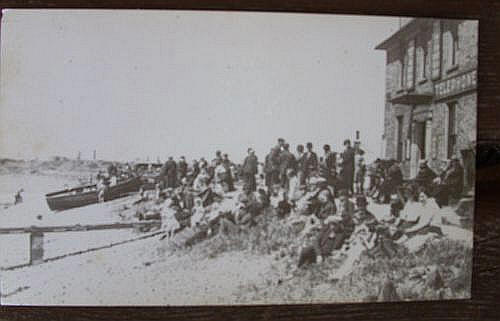
Three Crowns, Rainham Ferry - in 1920
The picture of “Three Crowns” was taken in 1920. The reason I know this to be true is because my Grandmother, shown on the right side of the picture, is standing outside the pub whilst holding her daughter (my Auntie) as a baby – who was born in the April of that year. - Margaret Armstrong
Both kindly provided by Colleen
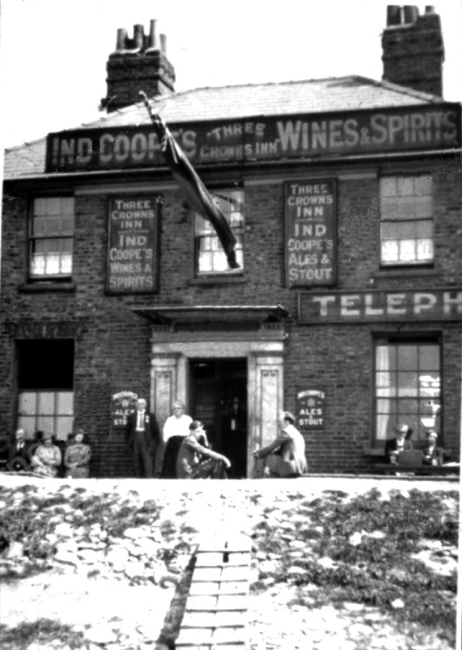
Three Crowns, Rainham Ferry - circa 1940
Kindly provided by John Carnaby
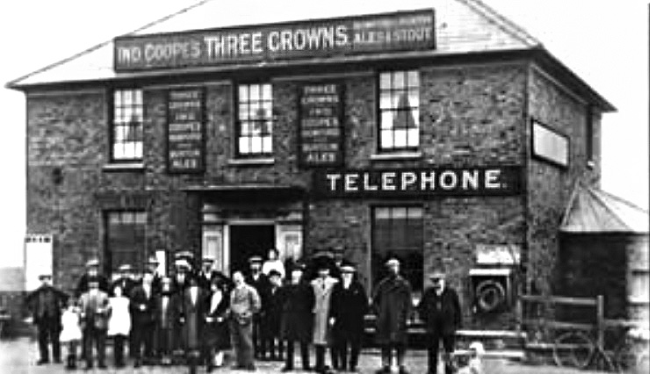
Three Crowns, Rainham Ferry - circa 1940 ?
Kindly provided by John Carnaby
Residents at this address.
The licensee in 1772 was recorded on the Alehouse Recognizances as Robett Lee, at the Three Crowns.
The licensee in 1776 was recorded on the Alehouse Recognizances as Robett Lee, at the Three Crowns.
The licensee in 1787 and 1792 was recorded on the Alehouse Recognizances as William Bradley, at the Three Crowns.
The licensee in 1800 was recorded on the Alehouse Recognizances as William Bradley, at the Three Crowns, Rainham.
The licensee in 1801 was recorded on the Alehouse Recognizances as William Bradley, at the Three Crowns, Rainham.
The licensee in 1804 and 1806 was recorded on the Alehouse Recognizances as William Bradley, at the Three Crowns, Rainham.
The licensee in 1810 was recorded on the Alehouse Recognizances as William Bradley, at the Three Crowns, Rainham.
The licensee in 1816 was recorded on the Alehouse Recognizances as William Bradley, at the Three Crowns.
The licensee in 1825 was recorded on the Alehouse Recognizances as William Bradley, at the Three Crowns.
1832-3/John Wade/../../../Pigots
1841/Mary Collins/Victualler/35/Essex/Census
1841/James parker/Male Servant/15/Essex/Census
1848/William Gore/Victualler/../../Whites
1851/John Heathcote/../../../Post Office
1851/Francis Benton/innkeeper/60/Hornchurch, Essex/Census **
1851/Mary Benton/wife/30/Wennington, Essex/Census
1851/John Benton/son/09/Hornchurch, Essex/Census
1851/Mary Benton/daughter/06/Hornchurch, Essex/Census
1851/Francis Benton/son/04/Hornchurch, Essex/Census
1851/Elizabeth Benton/daughter/02/Hornchurch, Essex/Census
1851/Henry Hall/father in law, ag lab/50/Essex/Census
1851/Sarah Bone/servant/23/Essex/Census
1852/J. Heathcote/../../../Kellys*
1860/William Clapham/../../../Kellys*
1861/William Clapham/Victualler/45/Finchley, Middlesex/Census
1861/Jane Clapham/Wife/47/Shrewsbury, Shropshire/Census
1861/William Clapham/Son/21/Middlesex/Census
1861/Charles Clapham/Son/19/Dagenham, Essex/Census
1861/Margaret Clapham/Daughter/16/Dagenham, Essex/Census
1861/Emma Clapham/Daughter/12/Dagenham, Essex/Census
1861/Frederick Clapham/Son/10/Dagenham, Essex/Census
1861/Caroline Clapham/Daughter/7/Dagenham, Essex/Census
1861/Susan Clapham/Daughter/1/Rainham, Essex/Census
1861/John Harris/Lodger, Labourer/65/High Bridge, Essex/Census
1862/William Clapham/../../../Kellys
1867/William Clapham/../../../Post Office
Note: Known as the Ferry House between 1860 & 1867
1870/William Clapham/../../../Kellys
1871/William Clapham/../../../Post Office
1871/William Clapham/Publican/51/../Census
1871/Jane Clapham/Wife/52/Finchley, Middlesex/Census
1871/Caroline Clapham/Daughter, Assistant/17/Dagenham, Essex/Census
1871/Susan Clapham/Daughter/10/Rainham, Essex/Census
1871/Charles Chambers/Boarder, Labourer/34/Eley, Cambs/Census
1874/William Clapham/../../../Kellys
1878/Mrs. Jane Clapham/../../../Kellys
1881/Jane Clapham/Innkeeper/64/Birmingham, Warwick/Census
1882/Mrs. Jane Clapham/../../../Kellys
1886/Mrs. Jane Clapham/../../../Kellys
1890/Mrs. Jane Clapham/../../../Kellys
1891/Jane Clapham/Licensed Victualler, Widow/68/Shropshire/Census
1891/Margaret Webb/Daughter/41/Dagenham, Essex/Census
1891/George Webb/Son in Law/33/Dagenham, Essex/Census
1891/Susan Boys/Grand Daughter/17/Dagenham, Essex/Census
1891/Harry Boys/Grandson/12/Dagenham, Essex/Census
1891/Charles Russell/Lodger, Geberal Lanourer/42/Bedford, Bedfordshire/Census
1891/David Webb/Lodger, Geberal Lanourer/24/Sittingbourne, Kent/Census
1891/George Thompson/Lodger, Geberal Lanourer/42/Rainham, Essex/Census
1894/Mrs. Jane Clapham/../../../Kellys
1895/Mrs. Jane Clapham/../../../Kellys
1898/Mrs. Jane Clapham/../../../Kellys
1899/Mrs. Jane Clapham/../../../Kellys
Jane Clapham died in September 1899 (BMD Romford 4a 353) when her grandson
Harry Boys took over as LV for the Three Crowns and is recorded in the 1901
Census as such. ***
1901/Harry Boys/Licensed Victualler/23/Rainham, Essex/Census ***
1901/Edwin Clark/Boarder, Wharf labourer/61/Standon, Essex/Census
1901/Stephen Staines/Boarder, Wharf labourer/44/Witham, Essex/Census
1901/Thomas Blaxland/Boarder, Wharf labourer/35/Milton, Kent/Census
1901/Charles Gibbs/Boarder, Wharf labourer/35/Sutton Bridge, Lincoln/Census
1901/Henry Saunders/Boarder, Wharf labourer/62/East Wood, Essex/Census
1901/John Keys/Boarder, Lighterman, Widow/45/Lambeth, Surrey/Census
1902/Charles A. Gibbs/../../../Kellys
1906/Robert A. Greening/../../../Kellys
1908/Robert A. Greening/../../../Kellys
1910/Robert A. Greening/../../../Kellys
1912/James Puttock/../../../Kellys
1914/Henry J. Hill/../../../Kellys
1917/Henry J. Hill/../../../Kellys
In 1921 at the Three Crowns, Rainham Ferry
Henry James Hill, Public House, Manager William White, Barge Builder, & Licensed Victualler aged 65 years 3 months and born in Isle Brewers, Somerset
Emma Hill, Wife aged 62 years 6 months and born in Harwich, Essex
1922/Henry J. Hill/../../../Kellys
1925/Arthur White/../../../Kellys
1929/Arthur White/../../../Kellys
1933/Arthur White/../../../Kellys
1937/Robert Biggin Stokes/../../../Kellys
Clock in the Bar at Rainham - 1936 newspaper article:
At Romford Petty Session on Thursday, G C Eley Esq, in the chair, Charles R
Bifield, manager of the Three Crowns Hotel, Ferry Lane, Rainham was summoned
for aiding and abetting Arthur H White to sell to Edward Wright intoxicating
liquor after permitted hours on December 29; and for supplying Wright with
liquor and aiding and abetting Wright to consume the liquor on the premises
other than during permitted hours. Edward Wright, Quadrant street, Canning
Town was summoned for consuming liquor other than during permitted hours,
and Arthur H White, the licensee of Hadleigh road, Leigh on Sea, was
summoned for selling by his agent, Bifield, intoxicating liquor to Wright,
and for supplying liquor.
Mr Stamp Wortley, prosecuting, said it was on Sunday, December 29 at 2.20 pm
and P S Rose and Det-Con Girt gave evidence.
Mr H Gilbertson, for the defendants, said the defence was that it all
happened before 2pm. The clock in the bar was a notoriously bad time-keeper.
Time was kept by Bifield with his gold watch and by a clock kept accurate by
Bifield. On December 28, Bifield set his watch by the clock tower at Rainham,
and at 2pm he called "Time" and put a glass cloth over the bar pulls. The
clock in the bar was kept fast on Sundays, because that was the only day on
which there were customers. The house was kept on because the licensee was
in business in the neighbourhood. It had been derelict, and when opened 18/-
was taken on the first day.
White said he had been connected with the business for 25 years, and had
never had a complaint.
Bifield said he had been manager for 13 years. There was no local trade, the
only customers being visitors. He denied that he sold drink after calling
"Time".
Wright said he had no drink after "Time" and others gave similar evidence.
Bifield was fined £3 on each of the three summonses, with £3 3/. costs;
White was fined £5 with £2 2/. costs; and Wright was fined £1.
* Provided
by the Pubs, Inns and Taverns Index for England, 1801-1900
** Provided by John Mead
*** Provided by John Jones
Provided by John Carnaby